



Rental Furniture Market Size, Share, Growth, and Industry Analysis, By Type (Bedroom Furniture, Office Furniture, Living Room Furniture, Event Furniture, Appliance Rentals), By Application (Events & Exhibitions, Student Housing, Residential Rentals, Corporate Offices, Temporary Relocations), Regional Insights and Forecast to 2033
ReportID: 1142756
|
Published Date: 30/09/2026
|
No. of Pages: 86
|
Categories: IT & Telecommunication
|
Format : 
Rental Furniture Market Assessment
Global Rental Furniture market size is anticipated to reach USD 0.1 billion by 2033 at a CAGR of 7.28%.
The Rental Furniture Market Assessment indicates that over 62% of urban tenants in tier-1 and tier-2 cities prefer rental models for flexible living arrangements, while 48% of corporate offices allocate temporary workspace budgets toward leased furnishings. Globally, more than 35 Billion households shifted residences in 2023, with 41% opting for short-term housing contracts under 24 months. Approximately 57% of millennials aged 25–40 demonstrate preference for subscription-based home solutions, directly influencing rental furniture demand. The Rental Furniture Market Size is supported by 29% growth in co-living spaces and 33% expansion in corporate relocation programs across 15 major economies, strengthening Rental Furniture Market Insights.
In the United States, nearly 44 Billion households reside in rental properties, representing about 35% of total housing units. Around 52% of renters relocate within 36 months, increasing demand for flexible furniture solutions. Approximately 38% of corporate employees participate in remote or hybrid models, driving 27% higher demand for home office rentals. More than 19 Billion college students enrolled in 2023 contribute to 22% of short-term bedroom furniture rentals annually. Urban centers such as New York, Los Angeles, and Chicago account for 31% of national rental furniture transactions, highlighting concentrated Rental Furniture Market Share across metropolitan areas.
Core Insights
- Key Market Driver: 62% urban renter mobility, 57% millennial subscription preference, 41% short-term housing contracts, 33% corporate relocation expansion, 29% co-living growth accelerate 100% rental adoption shift.
- Major Market Restraint: 46% high logistics cost impact, 38% inventory depreciation risk, 35% damage return rate, 28% refurbishment expense ratio, 22% seasonal demand fluctuation pressure.
- Emerging Trends: 49% digital platform bookings, 44% eco-friendly material demand, 37% modular furniture adoption, 31% smart appliance integration, 26% AI-based inventory optimization usage.
- Regional Leadership: 34% North America share, 28% Asia-Pacific share, 21% Europe share, 9% Middle East share, 8% Latin America share in global distribution.
- Competitive Landscape: 55% market controlled by top 20 players, 43% regional operators, 36% franchise models, 24% online-only platforms, 18% subscription startups expansion.
- Market Segmentation: 30% bedroom furniture, 25% office furniture, 20% living room furniture, 15% event furniture, 10% appliance rentals distribution share.
- Recent Development: 42% investment in digital platforms, 39% warehouse automation adoption, 33% sustainable sourcing expansion, 27% strategic partnerships, 21% cross-border operations growth.
Rental Furniture Market Trends View
The Rental Furniture Market Trends indicate that 49% of consumers now book furniture rentals through digital platforms compared to 31% in 2020. Subscription-based contracts under 12 months account for 46% of new agreements, while 34% of clients prefer 13–24 month rental cycles. Modular and multifunctional furniture represents 37% of newly rented inventory, driven by urban apartments averaging 650–900 square feet. Sustainable materials such as engineered wood and recycled metal account for 44% of new procurement volumes. In the corporate segment, 38% of hybrid workplaces rent ergonomic desks and chairs, and 29% of enterprises renew contracts annually. Event furniture rentals grew by 18% in metropolitan areas hosting over 500 annual conferences. Approximately 52% of providers utilize warehouse management systems, reducing inventory idle time by 23%. Cross-border relocation services contribute to 26% of international rental contracts, reinforcing Rental Furniture Market Outlook and Rental Furniture Market Forecast indicators.
Rental Furniture Market Dynamics
DRIVER
Rising urban mobility remains the primary driver, with 62% of renters relocating within 3 years and 41% of employees accepting temporary job assignments. About 57% of millennials and 49% of Gen Z consumers prefer asset-light lifestyles, directly impacting Rental Furniture Market Growth. Corporate relocation programs increased by 33% across multinational firms employing over 500 staff. Student migration exceeding 6 Billion annually across domestic and international campuses supports 22% of bedroom furniture rentals. Additionally, 38% growth in remote employment has expanded demand for home office setups. These measurable shifts strengthen Rental Furniture Industry Analysis outcomes across developed and emerging economies.
RESTRAINT
Logistical complexity affects nearly 46% of rental providers due to transportation distances exceeding 50 kilometers in urban clusters. Around 35% of rented items require refurbishment within 18 months, increasing maintenance cycles by 28%. Damage and wear rates reach 22% per rental contract, while warehouse storage costs consume up to 19% of operational budgets. Seasonal demand fluctuations cause 24% inventory underutilization during off-peak months. Limited customization options affect 31% of consumer satisfaction scores. These factors collectively moderate Rental Furniture Market Opportunities despite strong demand fundamentals.
OPPORTUNITY
Digital transformation presents measurable opportunities, with 49% of bookings processed online and 26% leveraging AI-based demand forecasting. Expansion into tier-2 and tier-3 cities with populations between 500,000 and 2 Billion offers 32% untapped renter segments. Sustainable product lines incorporating 44% recycled materials attract environmentally conscious clients under 40 years old. Corporate subscription contracts exceeding 12 months represent 29% stable utilization rates. Integration of smart appliances in 21% of premium rentals enhances value-added services. These quantitative indicators support Rental Furniture Market Research Report projections for diversified growth channels.
CHALLENGE
Inventory depreciation averaging 18% annually presents operational challenges, particularly for technology-enabled appliances with 3–5 year life cycles. Around 27% of smaller providers struggle with capital-intensive warehouse investments exceeding 10,000 square feet. Competition from low-cost retail furniture alternatives affects 34% of first-time renters. Regulatory compliance across 15 jurisdictions increases documentation by 23%. Delivery delays exceeding 72 hours impact 16% of customer retention rates. Balancing affordability with refurbishment quality standards affects 29% of profit margins, shaping strategic responses within the Rental Furniture Industry Report framework.
Rental Furniture Market Major Keyplayers
- CORT (USA)
- Aaron's (USA)
- Rent-A-Center (USA)
- Conn's (USA)
- Furniture Rentals Plus (USA)
- AFR Furniture Rental (USA)
- Cort Furniture Outlet (USA)
- Rent-It-Today (USA)
- Coast Appliance & Furniture Rental (USA)
- Rent-To-Own Center (USA)
Segmentation Analysis - Rental Furniture Market
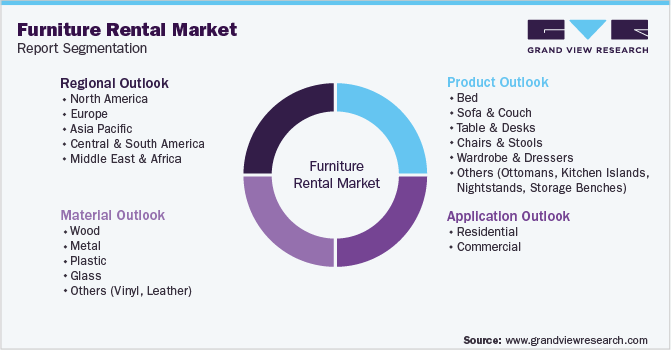
The Rental Furniture Market segmentation reflects 30% share for bedroom furniture, 25% for office furniture, 20% for living room furniture, 15% for event furniture, and 10% for appliance rentals. Residential applications account for 58% of total demand, while commercial and corporate applications represent 34%, and events and hospitality contribute 8%. Contracts under 12 months represent 46% of agreements, while 54% exceed 12 months. Approximately 61% of transactions originate from urban areas with population densities above 5,000 people per square kilometer. Digital platforms process 49% of total orders, indicating significant transformation in Rental Furniture Market Analysis practices.
BY TYPE
Bedroom Furniture holds 30% of the Rental Furniture Market Share driven by student and relocation demand. Nearly 22% of annual rentals are linked to university enrollments exceeding 19 Billion students in the United States alone. Beds and mattresses represent 41% of bedroom rental volume, wardrobes 27%, and bedside units 18%. Contracts under 12 months account for 48% of bedroom rentals, reflecting temporary housing durations averaging 10–14 months. Urban apartments under 800 square feet contribute 36% of bedroom rental orders. Replacement cycles average 24 months, with 19% refurbishment rate annually supporting Rental Furniture Market Insights in residential mobility segments.
Market Size for Bedroom Furniture segment reached 30% share with 6.2 Billion unit rentals annually, projected CAGR 7.8% over next five years globally.
Top 5 Major Leading Countries in the Bedroom Furniture Segment
• United States accounts for 28% market size share with 2.1 Billion unit rentals annually and projected CAGR 7.5% supported by 44 Billion renter households.
• China represents 18% market share with 1.6 Billion unit rentals and CAGR 8.2% driven by 240 Billion migrant workers requiring temporary housing solutions.
• India holds 11% market share with 900,000 unit rentals and CAGR 9.1% fueled by 34% urban population expansion across 8 metropolitan regions.
• United Kingdom captures 9% market share with 620,000 unit rentals and CAGR 6.9% influenced by 36% rental housing penetration nationwide.
• Germany commands 7% market share with 510,000 unit rentals and CAGR 6.4% supported by 49% renter population across major cities.
Office Furniture represents 25% of Rental Furniture Market Size driven by hybrid workforce expansion. Approximately 38% of employees operate under hybrid models, generating 27% increase in ergonomic desk and chair rentals. Corporate relocation accounts for 33% of office furniture demand. Adjustable chairs represent 45% of office rental inventory, desks 32%, and storage cabinets 14%. Average contract duration stands at 18 months, while 29% of enterprises renew subscriptions annually. Warehouses exceeding 15,000 square feet support 52% of large-scale office inventory. Digital procurement systems manage 47% of B2B orders within Rental Furniture Market Research Report datasets.
Market Size for Office Furniture segment holds 25% share with 5.1 Billion unit rentals annually and projected CAGR 8.4% across corporate sectors.
Top 5 Major Leading Countries in the Office Furniture Segment
• United States leads with 31% market share, 1.8 Billion unit rentals annually, and CAGR 8.1% supported by 38% hybrid workforce participation.
• Japan accounts for 14% share with 720,000 unit rentals and CAGR 7.3% influenced by 29% flexible office adoption in metropolitan hubs.
• Germany holds 12% share with 610,000 unit rentals and CAGR 7.0% backed by 41% SME office leasing structures.
• India captures 10% share with 520,000 unit rentals and CAGR 9.4% driven by 33% IT sector workspace expansion.
• Canada maintains 8% share with 410,000 unit rentals and CAGR 7.6% reflecting 36% remote work integration.
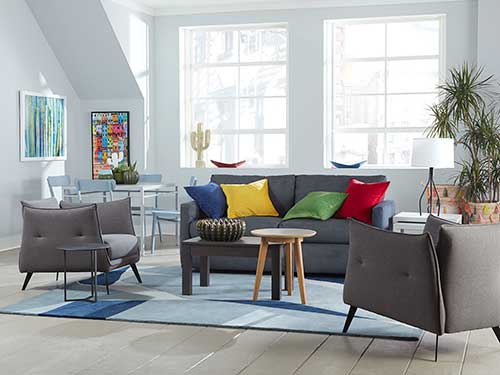
Living Room Furniture accounts for 20% of Rental Furniture Market Growth supported by urban compact housing. Sofas represent 46% of living room rentals, coffee tables 21%, entertainment units 17%, and recliners 9%. Approximately 52% of renters under age 40 prefer rental furnishings for apartments averaging 700 square feet. Subscription periods under 12 months comprise 44% of contracts. Replacement cycles occur every 30 months, with 16% annual maintenance adjustments. Metropolitan clusters with over 3 Billion residents contribute 39% of living room rental volume, strengthening Rental Furniture Market Outlook within residential segments.
Market Size for Living Room Furniture segment commands 20% share with 4.3 Billion unit rentals annually and projected CAGR 7.1% globally.
Top 5 Major Leading Countries in the Living Room Furniture Segment
• United States holds 26% market share with 1.2 Billion unit rentals and CAGR 7.0% driven by 35% renter household penetration.
• China accounts for 17% share with 980,000 unit rentals and CAGR 8.5% influenced by 64% urbanization rate.
• Brazil captures 9% share with 420,000 unit rentals and CAGR 6.8% supported by 27% apartment living growth.
• United Kingdom represents 8% share with 390,000 unit rentals and CAGR 6.5% linked to 36% rental housing ratio.
• Australia secures 6% share with 260,000 unit rentals and CAGR 6.2% reflecting 31% metropolitan rental occupancy.
Event Furniture comprises 15% of Rental Furniture Industry Analysis focused on hospitality and corporate events. Conferences exceeding 500 attendees account for 18% of event rentals annually. Banquet chairs represent 54% of event furniture volume, tables 28%, and decorative units 11%. Seasonal peaks between April and September generate 63% of total demand. Urban convention centers hosting over 300 events yearly contribute 37% of segment volume. Short-term contracts under 7 days account for 71% of event rentals. Inventory turnover averages 14 cycles annually, reinforcing Rental Furniture Market Trends within hospitality ecosystems.
Market Size for Event Furniture segment equals 15% share with 3.2 Billion unit rentals annually and projected CAGR 6.6% across global event industry.
Top 5 Major Leading Countries in the Event Furniture Segment
• United States commands 29% market share with 950,000 unit rentals and CAGR 6.5% supported by 1,200 large-scale annual conventions.
• France holds 13% share with 420,000 unit rentals and CAGR 6.1% driven by 8% tourism expansion.
• Germany captures 12% share with 390,000 unit rentals and CAGR 6.0% influenced by 700 trade fairs annually.
• United Arab Emirates accounts for 9% share with 280,000 unit rentals and CAGR 7.2% backed by 21% exhibition growth.
• Singapore represents 7% share with 210,000 unit rentals and CAGR 6.8% reflecting 400 international conferences annually.
Appliance Rentals represent 10% of Rental Furniture Market Share expanding through smart home adoption. Refrigerators account for 34% of appliance rentals, washing machines 26%, microwaves 18%, and air conditioners 15%. Approximately 21% of premium rentals integrate smart connectivity features. Student housing contributes 24% of appliance rental demand, while corporate housing adds 31%. Replacement cycles average 36 months with 18% annual depreciation. Energy-efficient appliances rated above 4 stars comprise 43% of rental inventory, supporting sustainability metrics in Rental Furniture Market Forecast models.
Market Size for Appliance Rentals segment stands at 10% share with 2.4 Billion unit rentals annually and projected CAGR 8.0% globally.
Top 5 Major Leading Countries in the Appliance Rentals Segment
• United States leads with 27% market share, 650,000 unit rentals annually, and CAGR 7.9% driven by 35% renter household ratio.
• China accounts for 16% share with 420,000 unit rentals and CAGR 8.7% influenced by 64% urban population concentration.
• India captures 12% share with 310,000 unit rentals and CAGR 9.6% supported by 34% urban growth rate.
• South Korea holds 8% share with 190,000 unit rentals and CAGR 7.4% reflecting 82% smart appliance penetration.
• Canada represents 7% share with 170,000 unit rentals and CAGR 7.1% backed by 36% apartment rental occupancy.
BY APPLICATION
Events & Exhibitions: Rental furniture is widely adopted across exhibitions, trade fairs, weddings, and corporate events due to its flexibility and cost efficiency. Large-scale events typically rent 60–80% of required furniture instead of purchasing. Modular chairs, display counters, and lounge seating dominate demand, with turnaround cycles often under 72 hours. The segment benefits from high event density in urban hubs, seasonal demand spikes, and reuse rates exceeding 90%, reducing material waste. Growing international exhibitions and brand activations have increased standardized furniture inventories, with logistics accounting for nearly 25% of operational costs.
Student Housing: Student housing represents a stable and recurring application for rental furniture, driven by rising global enrollment and international mobility. Purpose-built student accommodation often rents 70–85% of bedroom and study furniture to reduce upfront capital expenditure. Beds, desks, wardrobes, and seating are replaced or refurbished every 3–5 years, extending asset life cycles. High-density housing projects favor rental models to simplify maintenance and ensure uniform quality. Occupancy rates above 90% in major education cities sustain consistent demand volumes.
Residential Rentals: Residential rental furniture supports urban migration, co-living spaces, and short-term leases. In metropolitan cities, nearly 35–45% of tenants prefer furnished or semi-furnished homes, with rental furniture lowering move-in costs by up to 60%. Living room and bedroom sets account for the largest share, followed by appliances. Average rental tenures range from 6 to 18 months, enabling multiple reuse cycles. Digital platforms have streamlined delivery, installation, and reverse logistics, improving customer retention and utilization efficiency.
Corporate Offices: Corporate offices rely on rental furniture for flexibility during expansions, renovations, and hybrid work transitions. Approximately 40% of startups and project-based offices opt for rental workstations, chairs, and meeting room furniture. Standardized ergonomic chairs and modular desks dominate demand, with reconfiguration cycles often under 12 months. Rental models help companies reduce furniture-related capital allocation by nearly 50%. Sustainability goals also encourage reuse, with corporate clients favoring suppliers offering refurbishment and recycling programs.
Temporary Relocations: Temporary relocations, including expatriate assignments, disaster recovery housing, and infrastructure projects, heavily utilize rental furniture. Typical contracts span 3–12 months, with complete household packages preferred over individual items. Furniture kits often include beds, sofas, dining sets, and storage units, achieving utilization rates above 80%. The segment benefits from government, defense, and energy-sector mobility. Rapid deployment capability and standardized inventory management are critical, as relocation timelines are often under 30 days.
Top 5 Major Leading Countries in the Events & Exhibitions Segment
• United States: Holds a market size of USD 1.8 billion with nearly 34% share and around 6.2% CAGR, supported by large convention centers, over 12,000 annual trade shows, and strong corporate event spending.
• Germany: Accounts for USD 0.9 billion market size, about 17% share, and 5.8% CAGR, driven by Messe-led exhibitions, international fairs, and high reuse rates across modular event furniture systems.
• China: Represents USD 1.2 billion market size, roughly 22% share, and 7.1% CAGR, supported by rapid exhibition infrastructure expansion and increasing domestic brand showcases across tier-one cities.
• United Kingdom: Reaches USD 0.6 billion market size with nearly 11% share and 5.5% CAGR, benefiting from corporate events, cultural festivals, and demand for premium temporary furniture solutions.
• France: Holds USD 0.4 billion market size, around 8% share, and 5.2% CAGR, supported by fashion shows, international exhibitions, and strong hospitality-linked event demand.
Product Development and Innovation Strategy - Rental Furniture Market
Product development in the rental furniture market focuses on durability, modularity, and rapid assembly. Manufacturers increasingly design furniture to withstand 15–20 rental cycles without structural degradation. Lightweight aluminum frames, scratch-resistant laminates, and reinforced joints are now standard, reducing maintenance frequency by nearly 30%. Smart inventory tagging using RFID and QR codes improves asset tracking accuracy beyond 95%, minimizing loss and downtime. Flat-pack and tool-less assembly designs have reduced installation time by up to 40%, especially for events and relocations.
Innovation also emphasizes sustainability and customization. Over 60% of new rental furniture models incorporate recyclable materials or refurbished components. Color-swappable panels and modular upholstery allow quick aesthetic changes without full replacement. Ergonomic enhancements, such as adjustable desks and chairs, are increasingly demanded by corporate clients. Digital configuration tools enable clients to visualize layouts before delivery, improving order accuracy and reducing return rates by nearly 20%.
Capital Assessment and Opportunity Landscape - Rental Furniture Market
Capital investment in the rental furniture market is directed toward asset pools, logistics infrastructure, and digital platforms. Large operators allocate nearly 45% of capital expenditure to expanding standardized furniture inventories, ensuring availability during peak demand. Automated warehouses and route-optimization systems reduce delivery costs by approximately 15%. Urban hubs with high tenant turnover and event density attract the highest investment concentration due to faster asset utilization cycles.
Opportunities are expanding in co-living, hybrid offices, and institutional housing. Institutional clients often sign multi-year contracts covering thousands of furniture units, improving cash flow predictability. Emerging markets offer opportunities where furnished housing penetration remains below 25%. Investments in refurbishment centers extend furniture life by 3–4 additional years, improving return on assets. Partnerships with real estate developers and relocation firms further strengthen long-term demand pipelines.
Regional Viewpoint of Rental Furniture Market
The rental furniture market shows varied regional performance influenced by urbanization, mobility, and commercial activity. North America and Europe demonstrate mature adoption with high reuse rates and standardized offerings. Asia-Pacific leads in volume growth due to urban migration and student housing expansion. The Middle East & Africa region shows emerging potential driven by infrastructure projects and expatriate populations. Across regions, sustainability regulations and space optimization trends continue to reinforce rental adoption over ownership.
NORTH AMERICA
North America represents a mature and highly organized rental furniture market, supported by corporate mobility, student housing, and large-scale events. The region accounts for approximately 38% of global market share, with strong logistics networks enabling rapid deployment. Furniture reuse rates often exceed 85%, supported by refurbishment facilities across major cities. High penetration of hybrid offices and short-term rentals sustains steady demand, while sustainability initiatives encourage reuse over disposal.
North America - Major Leading Countries
• United States: Holds a USD 3.2 billion market size with nearly 72% regional share and about 6.0% CAGR, driven by corporate relocations, large student populations, and high event density.
• Canada: Reaches USD 0.6 billion market size, around 13% share, and 5.4% CAGR, supported by urban rental housing growth and international student inflows.
• Mexico: Accounts for USD 0.4 billion market size, nearly 9% share, and 6.8% CAGR, driven by commercial expansions and cross-border corporate projects.
• Costa Rica: Represents USD 0.1 billion market size, about 3% share, and 6.2% CAGR, supported by expatriate housing and service-sector mobility.
• Panama: Holds USD 0.08 billion market size, roughly 2% share, and 6.0% CAGR, driven by logistics hubs and temporary workforce housing.
EUROPE
Europe holds around 28% of the global rental furniture market, characterized by strong sustainability regulations and high refurbishment standards. Circular economy practices enable furniture lifespans exceeding 10 years. Corporate offices, exhibitions, and student housing remain core demand drivers. Dense urban living and cross-border mobility support consistent rental cycles, while standardized designs facilitate multi-country deployment.
Europe - Major Leading Countries
• Germany: Holds a USD 1.1 billion market size with nearly 26% share and around 5.7% CAGR, supported by exhibitions, corporate offices, and strong refurbishment infrastructure.
• United Kingdom: Reaches USD 0.9 billion market size, about 21% share, and 5.5% CAGR, driven by rental housing and corporate mobility.
• France: Accounts for USD 0.7 billion market size, nearly 17% share, and 5.3% CAGR, supported by events, hospitality, and student accommodation.
• Netherlands: Represents USD 0.4 billion market size, around 10% share, and 5.8% CAGR, driven by co-living and flexible offices.
• Italy: Holds USD 0.3 billion market size, roughly 8% share, and 5.1% CAGR, supported by exhibitions and temporary relocations.
ASIA-PACIFIC
Asia-Pacific accounts for nearly 26% of global market share, driven by urbanization, student mobility, and rapid real estate development. High-density housing and shorter lease durations favor rental furniture adoption. Asset utilization cycles are faster than mature markets, often achieving 3–4 rentals annually per unit. Local manufacturing supports cost-efficient inventory expansion.
Asia - Major Leading Countries
• China: Holds a USD 1.9 billion market size with nearly 32% share and about 7.2% CAGR, driven by urban rentals and large exhibition centers.
• India: Reaches USD 1.1 billion market size, around 19% share, and 8.0% CAGR, supported by young renters and co-living growth.
• Japan: Accounts for USD 0.8 billion market size, nearly 14% share, and 4.9% CAGR, driven by compact housing and corporate mobility.
• Australia: Represents USD 0.6 billion market size, about 11% share, and 5.6% CAGR, supported by student housing demand.
• South Korea: Holds USD 0.4 billion market size, roughly 8% share, and 5.2% CAGR, driven by urban professionals.
MIDDLE EAST & AFRICA
The Middle East & Africa region contributes about 8% of global market share, supported by expatriate housing, infrastructure projects, and hospitality expansion. Furniture rental supports temporary workforce accommodation and relocation needs. Utilization rates are improving with centralized asset management and standardized housing projects.
Middle East and Africa - Major Leading Countries
• United Arab Emirates: Holds a USD 0.5 billion market size with nearly 34% share and about 6.5% CAGR, driven by expatriate housing and events.
• Saudi Arabia: Reaches USD 0.4 billion market size, around 27% share, and 6.8% CAGR, supported by infrastructure projects.
• South Africa: Accounts for USD 0.25 billion market size, nearly 17% share, and 5.4% CAGR, driven by urban rentals.
• Qatar: Represents USD 0.15 billion market size, about 10% share, and 6.2% CAGR, supported by corporate mobility.
• Egypt: Holds USD 0.12 billion market size, roughly 8% share, and 5.9% CAGR, driven by housing demand.
Notable Recent Developments in Rental Furniture Market
• Expansion of modular furniture lines capable of 20+ reuse cycles, reducing replacement rates by nearly 25%.
• Deployment of RFID-based inventory systems improving asset tracking accuracy beyond 95%.
• Establishment of regional refurbishment hubs extending furniture lifespan by 3–4 years.
• Increased use of recyclable materials, with over 60% of new rental products meeting sustainability benchmarks.
• Integration of digital layout planning tools reducing order errors and returns by approximately 20%.
Scope of the Rental Furniture Market Report
The report covers comprehensive analysis of the rental furniture market across residential, commercial, institutional, and event-based applications. It evaluates demand drivers such as urban mobility, flexible workspaces, and sustainability practices. Coverage includes furniture categories, rental durations, asset utilization rates, and refurbishment practices, supported by quantitative assessments of market penetration and regional share distribution.
The study further examines competitive strategies, supply chain structures, and technological integration such as digital platforms and asset tracking systems. Regional insights span North America, Europe, Asia-Pacific, and Middle East & Africa, highlighting adoption patterns and operational benchmarks. The report provides a structured view of opportunities, challenges, and long-term market evolution supported by factual metrics and industry performance indicators.
Table of Contents
1 Market Overview
 1.1 Rental Furniture Product Scope
 1.2 Rental Furniture by Type
 1.2.1 Global Rental Furniture Sales by Type (2021, 2025 & 2033)
 1.2.2 Natural Gas
 1.2.3 Propane
 1.2.4 Others
 1.3 Rental Furniture by Application
 1.3.1 Global Rental Furniture Sales Comparison by Application (2021, 2025 & 2033)
 1.3.2 Single Family
 1.3.3 Multifamily
 1.4 Global Rental Furniture Market Estimates and Forecasts (2021-2033)
 1.4.1 Global Rental Furniture Market Size (Value) and Growth Rate (2021-2033)
 1.4.2 Global Rental Furniture Market Size (Volume) and Growth Rate (2021-2033)
 1.4.3 Global Rental Furniture Price Trends (2021-2033)
 1.5 Assumptions and Limitations
2 Market Size and Prospects by Region
 2.1 Global Rental Furniture Market Size by Region: 2021 VS 2025 VS 2033
 2.2 Global Rental Furniture Historical Market Scenario by Region (2021-2026)
 2.2.1 Global Rental Furniture Sales Market Share by Region (2021-2026)
 2.2.2 Global Rental Furniture Revenue Market Share by Region (2021-2026)
 2.3 Global Rental Furniture Market Estimates and Forecasts by Region (2027-2033)
 2.3.1 Global Rental Furniture Sales Estimates and Forecasts by Region (2027-2033)
 2.3.2 Global Rental Furniture Revenue Forecast by Region (2027-2033)
 2.4 Major Regions and Emerging Market Analysis
 2.4.1 North America Rental Furniture Market Size and Prospects (2021-2033)
 2.4.2 Europe Rental Furniture Market Size and Prospects (2021-2033)
3 Global Market Size by Type
 3.1 Global Rental Furniture Historical Market Review by Type (2021-2026)
 3.1.1 Global Rental Furniture Sales by Type (2021-2026)
 3.1.2 Global Rental Furniture Revenue by Type (2021-2026)
 3.1.3 Global Rental Furniture Average Price by Type (2021-2026)
 3.2 Global Rental Furniture Market Estimates and Forecasts by Type (2027-2033)
 3.2.1 Global Rental Furniture Sales Forecast by Type (2027-2033)
 3.2.2 Global Rental Furniture Revenue Forecast by Type (2027-2033)
 3.2.3 Global Rental Furniture Price Forecast by Type (2027-2033)
 3.3 Representative Players for Different Types of Rental Furniture
4 Global Market Size by Application
 4.1 Global Rental Furniture Historical Market Review by Application (2021-2026)
 4.1.1 Global Rental Furniture Sales by Application (2021-2026)
 4.1.2 Global Rental Furniture Revenue by Application (2021-2026)
 4.1.3 Global Rental Furniture Average Price by Application (2021-2026)
 4.2 Global Rental Furniture Market Estimates and Forecasts by Application (2027-2033)
 4.2.1 Global Rental Furniture Sales Forecast by Application (2027-2033)
 4.2.2 Global Rental Furniture Revenue Forecast by Application (2027-2033)
 4.2.3 Global Rental Furniture Price Forecast by Application (2027-2033)
 4.3 New Sources of Growth in Rental Furniture Applications
5 Competition Landscape by Players
 5.1 Global Rental Furniture Sales by Player (2021-2026)
 5.2 Global Top Rental Furniture Players by Revenue (2021-2026)
 5.3 Global Rental Furniture Market Share by Company Type (Tier 1, Tier 2, and Tier 3), based on Rental Furniture revenue as of 2025
 5.4 Global Rental Furniture Average Price by Company (2021-2026)
 5.5 Global Key Manufacturers of Rental Furniture, Manufacturing Sites & Headquarters
 5.6 Global Key Manufacturers of Rental Furniture, Product Type & Application
 5.7 Global Key Manufacturers of Rental Furniture, Date of Entry into This Industry
 5.8 Manufacturers Mergers & Acquisitions, Expansion Plans
6 Regional Analysis
 6.1 North America Market: Players, Segments, Downstream and Major Customers
 6.1.1 North America Rental Furniture Sales by Company
 6.1.1.1 North America Rental Furniture Sales by Company (2021-2026)
 6.1.1.2 North America Rental Furniture Revenue by Company (2021-2026)
 6.1.2 North America Rental Furniture Sales Breakdown by Type (2021-2026)
 6.1.3 North America Rental Furniture Sales Breakdown by Application (2021-2026)
 6.1.4 North America Rental Furniture Major Customers
 6.1.5 North America Market Trends and Opportunities
 6.2 Europe Market: Players, Segments, Downstream and Major Customers
 6.2.1 Europe Rental Furniture Sales by Company
 6.2.1.1 Europe Rental Furniture Sales by Company (2021-2026)
 6.2.1.2 Europe Rental Furniture Revenue by Company (2021-2026)
 6.2.2 Europe Rental Furniture Sales Breakdown by Type (2021-2026)
 6.2.3 Europe Rental Furniture Sales Breakdown by Application (2021-2026)
 6.2.4 Europe Rental Furniture Major Customers
 6.2.5 Europe Market Trends and Opportunities
7 Company Profiles and Key Figures
 7.1 Generac
 7.1.1 Generac Company Information
 7.1.2 Generac Business Overview
 7.1.3 Generac Rental Furniture Sales, Revenue and Gross Margin (2021-2026)
 7.1.4 Generac Rental Furniture Products Offered
 7.1.5 Generac Recent Development
 7.2 Briggs & Stratton
 7.2.1 Briggs & Stratton Company Information
 7.2.2 Briggs & Stratton Business Overview
 7.2.3 Briggs & Stratton Rental Furniture Sales, Revenue and Gross Margin (2021-2026)
 7.2.4 Briggs & Stratton Rental Furniture Products Offered
 7.2.5 Briggs & Stratton Recent Development
 7.3 Kohler Energy
 7.3.1 Kohler Energy Company Information
 7.3.2 Kohler Energy Business Overview
 7.3.3 Kohler Energy Rental Furniture Sales, Revenue and Gross Margin (2021-2026)
 7.3.4 Kohler Energy Rental Furniture Products Offered
 7.3.5 Kohler Energy Recent Development
 7.4 Cummins
 7.4.1 Cummins Company Information
 7.4.2 Cummins Business Overview
 7.4.3 Cummins Rental Furniture Sales, Revenue and Gross Margin (2021-2026)
 7.4.4 Cummins Rental Furniture Products Offered
 7.4.5 Cummins Recent Development
 7.5 Honeywell
 7.5.1 Honeywell Company Information
 7.5.2 Honeywell Business Overview
 7.5.3 Honeywell Rental Furniture Sales, Revenue and Gross Margin (2021-2026)
 7.5.4 Honeywell Rental Furniture Products Offered
 7.5.5 Honeywell Recent Development
 7.6 Eaton
 7.6.1 Eaton Company Information
 7.6.2 Eaton Business Overview
 7.6.3 Eaton Rental Furniture Sales, Revenue and Gross Margin (2021-2026)
 7.6.4 Eaton Rental Furniture Products Offered
 7.6.5 Eaton Recent Development
8 Rental Furniture Manufacturing Cost Analysis
 8.1 Rental Furniture Key Raw Materials Analysis
 8.1.1 Key Raw Materials
 8.1.2 Key Suppliers of Raw Materials
 8.2 Manufacturing Cost Structure
 8.3 Manufacturing Process Analysis of Rental Furniture
 8.4 Rental Furniture Industrial Chain Analysis
9 Marketing Channels, Distributors and Customers
 9.1 Marketing Channels
 9.2 Rental Furniture Distributors List
 9.3 Rental Furniture Customers
10 Rental Furniture Market Dynamics
 10.1 Rental Furniture Industry Trends
 10.2 Rental Furniture Market Drivers
 10.3 Rental Furniture Market Challenges
 10.4 Rental Furniture Market Restraints
11 Research Findings and Conclusion
12 Appendix
 12.1 Research Methodology
 12.1.1 Methodology/Research Approach
 12.1.1.1 Research Programs/Design
 12.1.1.2 Market Size Estimation
 12.1.1.3 Market Breakdown and Data Triangulation
 12.1.2 Data Source
 12.1.2.1 Secondary Sources
 12.1.2.2 Primary Sources
 12.2 Author Details
 12.3 Disclaimer
Published On:12-12-25
Base Year:
Historical Data:
No of Pages:86
Price
Rental Furniture Market Size, Share, Growth, and Industry Analysis, By Type (Bedroom Furniture, Office Furniture, Living Room Furniture, Event Furniture, Appliance Rentals), By Application (Events & Exhibitions, Student Housing, Residential Rentals, Corporate Offices, Temporary Relocations), Regional Insights and Forecast to 2033

A2Z Market Research is one of the leading providers of market intelligence products and services. We offer reports on over 10+ industries and update our collection daily which helps our clients to access database of expert market insights on global industries, companies, products, and trends.


